A well-designed wardrobe does more than store clothes. It helps keep your bedroom organised, makes everyday routines easier, and creates a clean, clutter-free living space.
In modern homes, especially where bedroom space is limited, making the most of every inch is important. A thoughtfully planned wardrobe can provide dedicated storage for clothes, accessories, footwear, bags, seasonal items, and other essentials without making the room feel crowded.
Whether you are designing a compact bedroom, a spacious master bedroom, or a children’s room, choosing the right wardrobe layout and internal storage arrangement can make a significant difference.
In this guide, we explore practical wardrobe design ideas that maximise storage while adding style and functionality to your home.
https://youtube.com/@divinehouseofficial?si=jRtAqIuH0LOI4BRc
1. Choose the Right Wardrobe Design for Your Bedroom
Before selecting colours, finishes, or handles, consider the available bedroom space and the amount of storage required.
Different wardrobe styles work better in different room layouts.
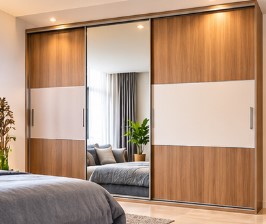
Sliding Door Wardrobe
Sliding wardrobes are ideal for bedrooms where there is limited space in front of the wardrobe.
Benefits:
- Doors slide horizontally without occupying additional floor space.
- Suitable for compact and modern bedrooms.
- Can be designed with mirrored or decorative panels.
- Offers a clean and contemporary appearance.
Best suited for: Small and medium-sized bedrooms where door-opening space is limited.
Hinged Door Wardrobe
Hinged wardrobes have doors that open outward and provide full access to the storage compartments.
Benefits:
- Easy access to the entire wardrobe interior.
- Convenient for organising shelves and drawers.
- Allows flexible internal configurations.
- Available in a wide range of finishes and handle styles.
Best suited for: Bedrooms with sufficient clearance in front of the wardrobe.
Floor-to-Ceiling Wardrobe
A floor-to-ceiling wardrobe uses the available vertical space from the floor up to the ceiling.
Benefits:
- Maximises storage capacity.
- Provides additional space for luggage, blankets, and seasonal clothing.
- Reduces unused space above the wardrobe.
- Creates a seamless, built-in appearance.
Best suited for: Bedrooms where additional storage is required without increasing the wardrobe’s floor area.
2. Make Use of Vertical Storage Space
One of the easiest ways to increase wardrobe storage is to use the full available height.
Instead of leaving unused space above the wardrobe, consider adding overhead cabinets.
Smart vertical storage ideas:
- Use upper cabinets for suitcases and travel bags.
- Store seasonal clothing and extra bedding in higher compartments.
- Keep frequently used clothing at an accessible height.
- Add separate sections for rarely used household items.
- Use loft storage to make better use of ceiling height.
Design tip: Keep frequently accessed items within comfortable reach and reserve higher shelves for items used occasionally.
3. Add Dedicated Sections for Different Clothing Types
A wardrobe becomes easier to use when every item has a designated place.
Instead of storing everything together, divide the wardrobe interior into sections based on your daily requirements.
Useful wardrobe compartments:
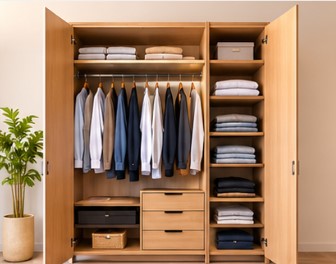
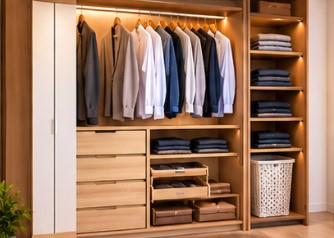
Hanging section: Ideal for shirts, trousers, dresses, jackets, and formal wear.
Folded clothing shelves: Suitable for T-shirts, jeans, sweaters, and everyday clothing.
Drawer units: Useful for undergarments, socks, accessories, and smaller personal items.
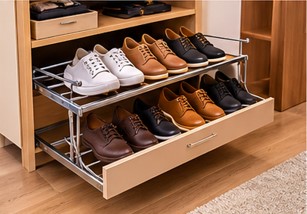
Shoe storage: Provides a dedicated space for footwear and helps keep the bedroom organised.
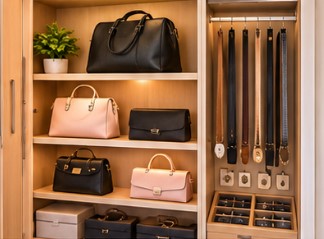
Accessory compartments: Can be used for watches, belts, ties, jewellery, and other essentials.
A well-divided wardrobe reduces clutter and makes it easier to locate items.
4. Include Pull-Out Drawers and Organisers
Pull-out drawers help maximise the usability of wardrobe interiors, particularly for smaller items that can easily become disorganised.
Storage additions to consider:
- Soft-close drawers for everyday clothing.
- Drawer dividers for accessories.
- Pull-out trays for watches and jewellery.
- Belt and tie organisers.
- Dedicated compartments for handbags.
- Laundry baskets for used clothing.
These features help keep smaller belongings organised without occupying unnecessary shelf space.
5. Design a Wardrobe with a Dedicated Shoe Rack
Footwear often occupies valuable bedroom or hallway space when it does not have a dedicated storage area.
Including a shoe rack within the wardrobe can help keep the room organised.
Shoe storage ideas:
- Pull-out shoe racks for easy access.
- Adjustable shelves for different shoe sizes.
- Separate compartments for everyday and occasional footwear.
- Ventilated storage sections to reduce odour accumulation.
- Lower wardrobe compartments for frequently used shoes.
Design tip: Consider the number and type of shoes in your household before deciding the size and number of shoe compartments.
6. Use Corner Wardrobe Designs Effectively
Corner spaces can become difficult to use when furniture is not planned properly.
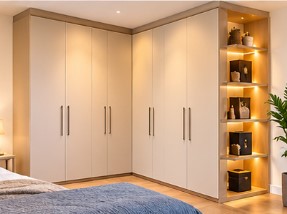
A well-designed L-shaped or corner wardrobe can turn an unused corner into valuable storage space.
Corner wardrobe ideas:
- L-shaped wardrobes for two adjoining walls.
- Corner hanging sections for longer garments.
- Adjustable shelves for folded clothing.
- Corner drawers or pull-out organisers where suitable.
- Overhead cabinets to increase storage capacity.
These designs are particularly useful in bedrooms with unusual layouts or limited wall space.
7. Add Mirrors to Make the Bedroom Feel Spacious
Mirrors are both functional and decorative elements in wardrobe design.
A full-length mirror can eliminate the need for a separate dressing mirror while making the room appear more open.
Mirror wardrobe ideas:
- Full-length mirror panels on sliding doors.
- Mirrored shutters combined with laminate finishes.
- A separate dressing section with a mirror.
- Mirror panels on selected wardrobe doors for a balanced appearance.
Mirrored wardrobes are especially useful in smaller bedrooms where visual openness is important.
8. Plan a Dedicated Dressing Section
If bedroom space permits, consider combining your wardrobe with a compact dressing area.
This creates a convenient space for getting ready while keeping personal accessories organised.
Dressing area features:
- A full-length or wall-mounted mirror.
- Small drawers for cosmetics and accessories.
- Open shelves for frequently used products.
- A comfortable stool or compact seating.
- Suitable lighting around the mirror.
A dressing section can be integrated into the wardrobe design rather than planned as a separate furniture unit.
9. Choose the Right Wardrobe Materials and Finishes
The material and finish you choose influence the appearance, durability, maintenance, and overall cost of your wardrobe.
Common wardrobe materials
Plywood
- Commonly used for wardrobe carcasses and shutters.
- Available in different grades and thicknesses.
- Suitable for a variety of laminate and veneer finishes.
- Requires appropriate edge protection and moisture management.
MDF (Medium-Density Fibreboard)
- Provides a smooth surface for painted and decorative finishes.
- Can be used for certain wardrobe components.
- Standard MDF is not suitable for prolonged exposure to moisture.
Particle Board
- Often used in budget-friendly modular furniture.
- Available in laminated finishes.
- Requires proper edge sealing and protection from moisture.
Popular wardrobe finishes
- Matte laminates for a subtle, modern appearance.
- Glossy laminates for a brighter look.
- Wood-finish laminates for a warm, natural feel.
- Veneer finishes for a premium appearance.
- Acrylic finishes for a sleek, contemporary style.
Choose materials according to the room’s moisture conditions, expected usage, budget, and maintenance requirements.
10. Use Lighting to Improve Wardrobe Functionality
Proper lighting makes it easier to find clothing and accessories, especially inside deep wardrobes.
Wardrobe lighting ideas:
- LED strip lighting inside wardrobe sections.
- Sensor-based lights that switch on when doors open.
- Lighting below shelves and inside drawers.
- Dedicated lighting for dressing mirrors.
- Warm or neutral lighting based on the bedroom’s overall design.
Concealed wiring and suitable electrical provisions should be planned before wardrobe installation.
11. Choose Space-Saving Wardrobe Accessories
Smart wardrobe accessories can improve storage without increasing the wardrobe’s external dimensions.
Consider incorporating:
- Pull-down hanging rods for higher sections.
- Sliding trouser racks.
- Pull-out laundry baskets.
- Rotating corner organisers.
- Adjustable shelves.
- Multi-level hanging rods.
- Hidden accessory trays.
- Storage boxes for seasonal clothing.
Select accessories based on actual storage requirements rather than adding features that may rarely be used.
12. Common Wardrobe Design Mistakes to Avoid
Even a stylish wardrobe can become inconvenient if its internal layout is not planned properly.
Here are some common mistakes to avoid:
Mistake 1: Not measuring the available space accurately
Incorrect measurements can affect wardrobe depth, door movement, and access.
Solution: Measure wall dimensions, ceiling height, skirting, switches, and nearby furniture before finalising the design.
Mistake 2: Ignoring internal storage requirements
A wardrobe with too many shelves or too little hanging space may not suit everyday usage.
Solution: Plan compartments according to the type and quantity of clothing and accessories.
Mistake 3: Leaving unused vertical space
A short wardrobe may leave valuable space between its top and the ceiling.
Solution: Consider overhead cabinets or loft storage where suitable.
Mistake 4: Choosing the wrong door style
Hinged doors may obstruct movement in compact bedrooms, while sliding doors may limit access to part of the wardrobe at a time.
Solution: Select the door mechanism according to room dimensions and usage.
Mistake 5: Ignoring ventilation and moisture
Poor moisture management can affect stored clothes and wardrobe materials.
Solution: Address dampness in the room, provide suitable ventilation, and choose moisture-appropriate materials.
Mistake 6: Not planning electrical points
Adding wardrobe lighting after installation may require modifications.
Solution: Coordinate lighting, switches, and wiring during the interior planning stage.
Conclusion
A well-designed wardrobe combines smart storage, practical organisation, and attractive finishes. From floor-to-ceiling wardrobes and sliding doors to pull-out organisers, dedicated shoe racks, and integrated dressing areas, there are many ways to maximise storage in a bedroom.
The key is to plan the internal layout according to your lifestyle, available space, and storage requirements rather than focusing only on the exterior appearance.
Frequently Asked Questions (FAQs)
1. Which wardrobe design is best for maximum storage?
Floor-to-ceiling wardrobes with a combination of hanging sections, shelves, drawers, and overhead cabinets can provide excellent storage. The best layout depends on the bedroom dimensions and household requirements.
2. Are sliding wardrobes better for small bedrooms?
Sliding wardrobes are often suitable for compact bedrooms because their doors do not swing outward. They help save clearance space in front of the wardrobe.
3. What is the ideal depth for a bedroom wardrobe?
A wardrobe depth of around 600 mm is commonly used for full-size hanging storage, but the final dimensions depend on clothing requirements, hanger orientation, door mechanism, and available room space.
4. How can I increase wardrobe storage without making it bigger?
Use adjustable shelves, pull-out drawers, vertical storage, overhead cabinets, multi-level hanging rods, and dedicated organisers to make better use of the existing space.
5. Which material is best for wardrobe construction?
Plywood, MDF, and particle board are commonly used for different wardrobe components. The right material depends on the application, budget, finish, moisture conditions, and expected durability.
6. Is a floor-to-ceiling wardrobe a good idea?
Yes. It makes use of vertical space and provides additional storage for luggage, blankets, and seasonal items. Proper access planning is important for higher compartments.
7. How can I organise a wardrobe for a family?
Divide the wardrobe into individual sections for each family member. Provide separate hanging areas, shelves, drawers, and accessory compartments based on individual storage needs.
8. Are mirrored wardrobes suitable for small rooms?
Yes. Mirrored wardrobe panels can make a bedroom appear brighter and more spacious while serving as a functional dressing mirror.
9. What lighting is best for wardrobes?
LED strip lights and sensor-based lighting are popular options. They improve visibility inside shelves, drawers, and hanging sections.
10. When should wardrobe planning begin during house construction?
Wardrobe planning should begin during the interior design stage. Final dimensions, electrical points, wall conditions, and furniture layouts should be coordinated before installation.